
Life In The Minors: Do Or Die with Chris Rojas
03/27/2011, 9:51pm EDT
By Steve Sidoti, Photos Courtesy of Chris Rojas
Minor League Stardom and WBC Appearance Highlight the Unique Baseball Journey of Former NYIT Walk-On Chris Rojas
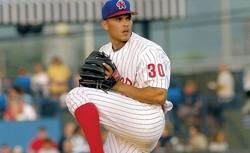
It was during the winter of 2006, and Chris Rojas was living a dream. He was teammates with big league stars such as Ivan Rodriguez, Carlos Delgado, Carlos Beltran, Alex Rios, and Javier Vazquez among others.
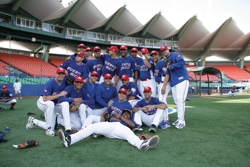
Chris and his boyhood idol, Bernie Williams, were locker mates, as the two shared a clubhouse with the rest of Team Puerto Rico, who represented the country in the World Baseball Classic. However, the path that Rojas took to get there was unlike the others. His journey into minor league stardom, pro accolades, and a near call-up to the big leagues remains a unique and interesting story from beginning to end.
As a child, Chris Rojas grew up in the rough Brooklyn neighborhood of Bedford Stuyvesant. His first interactions with the game of baseball came at the age of four, when his mother would toss him batting practice in the backyard. It was not until high school that he participated in organized baseball fulltime, having played just one year of little league. Wherever he played, it was tough not to wear his emotions on his sleeve.
“From where I came from, it was ‘Bed Stuy’ do or die,” said Rojas. “You either toughen up or you get your behind kicked. The same mentality I had when I played was the same mentality I had at home. You talk loud and defend and protect yourself.”
In his first two years of high school at Transit Tech in Brooklyn, Rojas found a spot as the starting second baseman at the varsity level. He was not much of a hitter, but he was always penciled into the lineup.
Family matters would force Rojas to miss the second half of his sophomore season as well as the entire next one as a junior. Before his last year of high school, his family had moved out of Brooklyn and into Great Neck, Long Island, which was quite the adjustment.
As a transfer, Rojas spent his senior year of high school at Great Neck South High School. It was there that he continued his baseball career, while also playing football and basketball.
After graduating from high school in 1994, Chris had his mind set on attending John Jay College in Manhattan, despite the fact that his high school coach had been trying to convince him to play for Coach Bob Hirschfield at the New York Institute of Technology. Despite his desires and already being enrolled at John Jay, Chris took his coach’s advice, and set forth to the campus in Old Westbury, New York and walked-on to the baseball team.
Rojas began pitching on occasion during his sophomore and junior seasons. As a junior, he played most of his games as a center fielder. Although he enjoyed modest success, off the field issues limited him from reaching his full potential. Rather than dismiss the walk-on from the team, his coach took a different route.
“I did some things off the field that he (Coach Hirschfield) could have told me to take a hike,” Rojas said. “I wasn’t on a scholarship and I did things that were inappropriate. That time for me was a learning curve. It was Coach Hirschfield who stuck with me and eventually offered me a scholarship.”
Midway through his junior season, Rojas injured the ulnar collateral ligament in his right elbow when a teammate, who was then playing left field, stepped on his arm. This forced him to undergo Tommy John surgery that summer.
In order to continue pitching, Rojas was given the option to sit out his senior season and return for a fifth year. He declined, rather opting to play first base and serve as the team’s designated hitter on a weekly basis, despite recovering from surgery.
After his final college season, Rojas was unsure as to where baseball would take him next. Luckily, Coach Hirschfield remained on his side. It was Hirschfield and a former NYIT and independent league player who put in a good word for Rojas to front office members of the Canton Crocodiles, then an independent league team of the Frontier League.
At the end of the Crocodiles season he was just one of six players that remained with the team from Opening Day. Rojas was still in the process of regaining his arm strength from Tommy John surgery, but just like Hirschfield, the Canton coaches saw something in him and kept him around. After the season in Canton, Ohio, the Pittsburgh Pirates offered Rojas the chance to partake in a tryout.
The Pirates tryout took place in Chicago, Illinois where twenty position players and twenty pitchers participated for the chance to be offered a contract. Rojas was the last pitcher to throw that day. “It may have worked to my benefit being the last guy,” he said. “After they saw everyone, I may have shined a little bit. Once I was done, Bill Bryk, Pirate Pitching Coordinator, and a scout pulled me over to the side and asked if I wanted to be a Pirate.”
Rojas began his career in the Pirates organization playing in Short-Season Single-A ball in 1999. That year, he led his team in wins, strikeouts, and innings pitched.
After one year with the Pirates, Chris was let go. Luckily, there was Bill Bryk who would give him his second opportunity to play in the minors leagues. Byrk, at the time with the Padres, was going to give him another chance. At a private tryout in Fort Wayne, Indiana, Bryk was assured that Rojas was the same pitcher that he had tried out one year prior. Thanks to Bill Bryk, Chris was now a part of the Padres organization.
Following one Single-A outing in the Midwest League, Chris was approached by the opponent's pitching coach, who also happened to coach in the Puerto Rican Winter League.
“The coach set off a conversation with me and found out about my background and that my family is from Puerto Rico,” Rojas said. “He asked me if I would be interested in playing winter ball. For me, when you’re in the game, you start to realize the importance of getting outside of the minor leagues and gaining other experience, so I was ecstatic for the opportunity.”
Ultimately, Rojas played in eight seasons in the Puerto Rican Winter League for the Mayaguez Indios, a team with a rich winning tradition. From the get-go, he achieved success.
“I got to pitch a lot right away which was unheard of,” he said. “I finished second in the Rookie of the Year voting. At the time, it was a big deal. I was facing guys like Carlos Beltran and Roberto Alomar. I remember facing Alomar, and this was the year he was like third in the MVP voting, and striking him out.”
Rojas was also able to participate in two Caribbean World Series. “The first one was actually in Puerto Rico and we were hosting it,” he said. “The place was packed from end-to-end and I heard so many stories about what it would be like.
“You quickly understand that although this is a game for you to enjoy, you realize how much people care and want you to win. It brings it to a different level than playing in a minor league stadium. It's just a different intensity level. You're playing with guys who are big leaguers and are more experienced. So it draws a different atmosphere and it was a great experience for me.”
In 2002, Chris was a part of a Double-A staff recognized by Baseball America as the best starting rotation in the history of the minor leagues. The 5-man rotation also included Jake Peavy, Ben Howard, Dennis Tankersley, and Eric Cyr. “They were looking at us as the future of the organization from a pitching standpoint,” Rojas said. “They would try to see who they could give an opportunity to and who was going to step up. “It was evident that Peavy was going to be good because he was so young and he was one of the league leaders in multiple categories,” he said. “For a guy to be that good and that young, it was obvious that he was going to have success.”
That year, Chris was experiencing some of his own success to start the season. It was just around this time that he gained prospect status, having been ranked as high as the 20th best prospect in the organization by Baseball America.
He was able to put a string of starts together where he won five games in a row, including one game with a no hitter through 8 2/3 innings. After that outing, the Padres sent minor league director Ted Simmons to watch his next start. Simmons, the well known coach, executive, and former eight-time All-Star in the major leagues, would decide if Rojas had the stuff to pitch at the sport's highest level. Sadly, the start did not go the way Rojas had hoped.
“Unfortunately, the outing that he (Simmons) came to see me, I did not pitch well at all,” he said. “I had bad mound presence and I didn't carry myself. That was disappointing but I knew the window of opportunity was there.”
It was an up and down journey the next few seasons for Rojas, but he kept working. In 2005, at the age of 28, Chris signed a minor-league deal with the Phillies.
With a record of 12-7, and 111 strikeouts compared to just 38 walks between Double-A and Triple-A, Chris was awarded the high honor of being named the pitcher of the year in the Phillies organization. Talent evaluators watched him earn a win in ten straight starts. Unfortunately, Chris went down with an injury in early August, and was forced to shut down for the remainder of the season, finishing with just one Triple-A start.
“I had the notion in my head that if I could stay healthy, I would be a September call-up because I was doing so well,” he said. “But unfortunately I wound up getting hurt.
The biggest thrill for Rojas came in 2006, when he made the Team Puerto Rico roster for the World Baseball Classic (WBC). The 2006 WBC took place from March 3-20 and was implemented by Major League Baseball, consisting of teams representing sixteen countries. Numerous players with big league experience were obvious candidates for Team Puerto Rico, but when it came time to look elsewhere, Rojas was a leading applicant because of his accomplishments in winter ball.
“After the training that we had in Port St. Lucie, we were heading to Puerto Rico on a charter bus,” Rojas said. “Carlos Delgado, who was sitting in the front, gets up on the microphone. There were four or five of us, who weren’t major leaguers that were on the team, so he had us individually come to the front of the bus and we had to introduce ourselves, say where we were from, sing a song, and say who our favorite baseball player was.” Ironically, Rojas’ favorite player, Bernie Williams, was sitting in the back of the bus playing a guitar.
Another great thrill in the tournament came on opening night at Hiram Bithorn Stadium in San Juan, Puerto Rico. “The place was literally vibrating and I just got goosebumps because of it. “There really was a lot of pride during the World Baseball Classic,” he said. “Even guys with a championship ring, guys who were former All-Stars and made so much money, said that this was bigger than playing in the World Series because they were representing their nation. For them to say it was bigger than the World Series was powerful and something special.”
Despite sharing a locker next to Bernie Williams, Rojas tried to hold himself as a peer and resented the notion of being awestruck. Chris Rojas was representing his country and learning so much in the process. On a daily basis during the three-week tournament, he witnessed the everyday intensity of Ivan Rodriguez, the strong focus of Javier Vazquez, the hard work put in by Carlos Beltran, and the ways in which Bernie Williams studied and observed opponents before games. Chris even had catches with Joel Pineiro, who reinforced to him the importance of throwing downhill and getting an angle on the baseball.
Unfortunately, from a performance standpoint, the team went 4-2 and failed to qualify for the Semifinals. In the six games, Chris Rojas made one appearance, pitching one inning of relief and retiring all three batters he faced. It was a time in his life that he will never forget.
“Being selected to play in the WBC is by far the best experience and biggest joy that I had playing the game,” he said. “Those experiences were amazing.” After the WBC, Chris returned to Pirates, the team that offered him his first minor league deal. However, he made just three starts that season because of a strained flexor tendon that he suffered during winter ball before participating in the WBC. At the time, he pitched through the injury just to make Team Puerto Rico. Even during the time of the tournament, he simply didn't have strength or velocity, throwing just 82 mph compared to his usual 88-92 when healthy.
“I didn’t want to end my career coming up lame and unable to finish out a season, so I decided to get back into shape,” he said. Chris continued to play through another season of winter ball, but did not receive any minor league offers as teams remained unsure about his health. It was then that he decided to end his career where it began, playing independent league baseball.
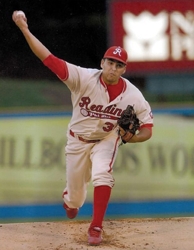
Rojas pitched in five games for the Somerset Patriots of the Atlantic League, playing under former Yankee and Cy Young Award winner, Sparky Lyle. A quarter of the way through the season, Rojas was called out of the dugout during a game and was told that the Phillies had purchased his contract. It was then that Chris headed to Double-A Reading to finish his career just the way he wanted. He went 7-4 the rest of the way, and happily retired from the sport that had given him so much.
Soon after Rojas had ended his playing career, job offers had come his way. Despite the offers, Rojas was certain that he did not want to return to the rigors of minor league baseball.
“I didn’t want to be involved in the game coaching at the minor league level,” he said. “That’s why I stopped playing. I stopped playing because I didn’t want to be in the minor leagues anymore. I didn’t want to continue that grind. I also knew that my biggest asset to an organization is being bilingual and I know that the bilingual coaches are really kept at the lower levels because that’s where most of the Latin players are, and I didn't want to do that. I knew that I wasn’t a big league player, so to ever become a major league pitching coach was going to be really, tough.”
It was not until the summer of 2010, that Chris really got back involved with the game of baseball, He managed the Long Island Collegians, a collegiate summer league team, of the ACBL. “That was an extreme joy and I think I can speak for the coaching staff as they would say the same thing,” he said of coaching the Collegians. “Other than playing, being involved with the team and the guys was a lot of fun.”
In addition, this spring Rojas will manage the JV baseball team at St. Dominic High School in Oyster Bay, New York. His entire baseball career was a dream come true and a journey unlike many others. Looking back, Chris Rojas wouldn't have had it any other way. “I have no regrets,” he said. “I traveled the United States, traveled the Caribbean, and repre- sented a nation. It was awesome."
Tag(s): Columns Home Life In The Minors
