
Torque AP: Importance of Leg Work
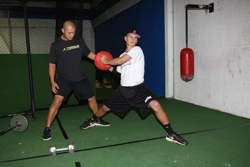
Fig. #1 Matt Vogel, RHP/SS Pat-Med H.S.
We all know that pitchers must run, but do we know exactly why? This is a question that has three scientific answers. Running is a very general word; there are many types of running. The combination of anaerobic and aerobic types of running will increase velocity, and also help prevent injuries. What I mean by anaerobic running is explosive sprints, uphill sprints, or resistance sprints. Anaerobic running will train the body to be explosive while enhancing muscle size (hypertrophy) and power output. Another thing anaerobic running does is increase the stride length of the pitcher, which in turn allows a pitcher to release the ball closer to home plate. Now that you have an understanding of why anaerobic running helps in pitching performance let talk about aerobic running and how that helps a pitcher. It may seem to be pointless to run at a slow pace for a long duration of time, because baseball in general is an explosive sport. Every aspect of the game, whether it’s hitting or pitching, is a burst, then a rest. So why must pitchers run long distances? After an outing, hard bullpen, or a long toss session there is a by-product call lactic acid which builds up in your throwing arm, and decelerates muscles. If this lactic acid is not "flushed", the healing and building process will be hindered. This leads to prolonged soreness and muscle and tendon tightness, and tight muscles are more likely to tear. So, after every hard throwing session pitchers must run! There are a few different options. A conventional flush would consist of a 20-30 minute jog at a relatively moderate pace. Another option is to "flush" the arm by doing 8-12 poles (foul pole to foul pole) at a sprint, with 30 second break periods. The last option is to do a combination of both. The combination of post throwing, running and arm excercises will effectively flush the lactic acid and kick start the healing process.
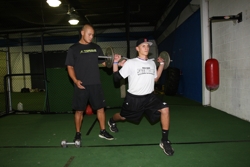
Fig. # 2
Now let’s get to the fun part, weight training and plyo-metrics. The perfect examples of serious leg work are Nolan Ryan, Andy Petite, and Roger Clemens. All of these pitchers have tremendous lower half strength and flexibility. It’s no coincidence they all pitched into their 40's! I'm not going to lie and say that leg work is easy, because it’s not! It’s probably the hardest body part to train, due to the amount of muscle mass that is involved. True leg work is taxing not only on your legs but also on your cardiovascular system which is what makes it so hard. Let’s talk about the motive; why do pitchers need to work their legs and core in the weight room more and any other body part? Let me ask you a question, would you rather build a house on quick sand or concrete? It’s a no-brainer! Your legs are your base, if you don't have a strong base you can’t be stable as you unwind your core and shoulders to throw the baseball. Hence, you will lose velocity and be inconsistent. You don't necessarily need huge legs to have strong legs. I will always put more emphasis on leg and hip flexibility than size and strength, because strength without flexibility is obsolete, and will actually make you less explosive and throw slower. Each player must have their own program designed to enhance their strengths and diminish their weaknesses.
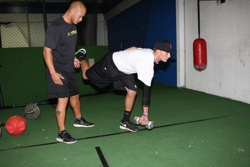
Fig. # 3
Back to the subject of how strong and flexible legs will lead to more velocity and consistency. As a pitcher lifts his/her leg to start the delivery, the back leg and gluteus must be able to hold all the pitchers weight while allowing the lead knee to get to chest height. This requires tremendous hip flexor strength and hamstring flexibility. As the pitcher "falls" towards home plate the back leg has to remain loaded as long as possible until the front foot is about the strike the ground. This movement is very similar to side lunge fig 1. As the pitcher reaches foot strike, the back leg will now be in triple extension (hip, knee, and ankle - extension) which now means all of the weight has now been transferred onto the front leg. As the hips and shoulder unwind the pitcher is now in position very similar to a conventional barbell lunge fig 2. After the ball is released and the arm follows through, the momentum of the arm will lift the back foot off the ground. In this instant there is a huge demand put on the glutes and hamstring of the front leg. This position is very similar to a single leg RDL (Romanian Dead Lift) fig3. As you can see from the pictures the correct leg training can be extremely beneficial to all throwing athletes, especially baseball pitchers! Do not try these exercises without consulting a Certified Strength and Conditioning Specialist (CSCS).
Tag(s): Columns Pitching Columns Home All News Torque Athletic Perform

Comments
Please login to comment.
Let’s get the conversation started! Post your comment.