
Torque AP: Tilt Shoulders Up to Throw Down Hill: The Seesaw Effect
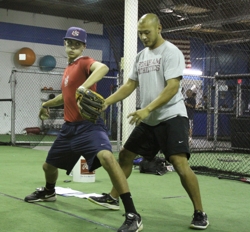
If you’re around baseball enough, you will hear coaches yelling at their pitcher to “work down hill!, get on top of it!” It sounds like a great idea but what do they mean and how does a pitcher throw down hill? I’ve been around the game for roughly 20 yrs and the most common method that I’ve heard and seen coaches teach pitchers is to get their hand up and out so their palms are facing the sky or centerfield. Although this may seem to get you “on top” this method is completely unnatural and also puts the rotator cuff and UCL in a compromised position. (Bucket test) I will put it as simply as possible, the further away from your body the ball gets the more strain you put on the rotator cuff and the UCL, The bucket test is a simple way to prove how much more stable you shoulder is when the ball remains by the thrower's back hip ( natural state). If you pick up a bucket of baseballs, lets say, with your throwing arm, and move it laterally away from your body you will notice the strain that it puts on the shoulder. If you’ve tried the bucket test, you understand how breaking your hand up and out will lead to arm injury.
I will now explain why one must tilt their shoulder up in order to throw down hill. In a previous article I spoke of torque and equilibrium. Torque is a rotational force and equilibrium is the body’s natural state. Both of these key scientific terms play a huge roll in throwing down hill. Let’s work backwards from release point to the hand break. At release, a pitcher wants their throwing shoulder to be above the glove shoulder, thus creating tilt and a downward throwing plane. As we rewind, the throwing shoulder will gradually flatten and finally the glove shoulder should be above the throwing shoulder. This is what I call the “Seesaw-effect”. The seesaw effect is the result of the body’s natural tendency to return to equilibrium. When the pitcher tilts his/her shoulders at an upward angle in the beginning of their delivery, by the time they get to the release point, the throwing shoulder will end up above the glove shoulder resulting in the seesaw effect thus allowing the pitcher to throw down hill naturally.
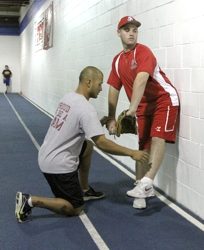
Besides creating a downward throwing angle, the seesaw effect, if done correctly, will allow the pitcher to load much more weight on the back side leading to more velocity and less pressure on the throwing arm. Another result of the Seesaw-effect is that it will allow you to throw a sharper curveball with more depth. Reason being, when you throw a curveball, you must get on top of the ball and if your shoulder's are flat, it is virtually impossible to do so without putting a lot of pressure on the UCL.
Now that we have somewhat of an understanding of why we must tilt our shoulders to throw down hill, lets discuss how to accomplish this tilt. Although we are talking about creating tilt with our shoulder, it’s very important that you understand that the hips must tilt as well in order to use our bodies to the max. The shoulder tilt is initially created by the hip load. If you do not load your hips properly; it will be much harder to get into a position of proper shoulder tilt. The rest is easy! After the initial angle is created, it's just a matter of unwinding our bodies 180 degrees as we “fall” towards home plate. The energy that is produced from the combination of “the fall” and rotation is transferred into the ball on a downward plane, Using these methods, you are putting your body in a better position to throw down hill!
Tag(s): Columns Pitching Columns Home All News Torque Athletic Perform

Comments
Please login to comment.
Let’s get the conversation started! Post your comment.