
Making the Pitch

Steven Kimmelman, Photos by Ellen Schuerger
Always throw down hill. As you follow through, whip the throwing arm across the body from eleven o'clock to five o'clock (outside the opposite knee).
The Arsenal:
Four-Seam Fastball
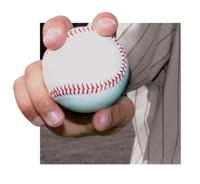
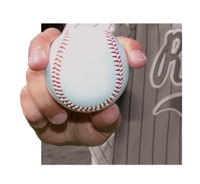
The four-seam fastball is called a four seamer because when the ball is thrown the ball rotates such that there are four seams rotating in the air. This pitch typically will stay straight depending on your arm angle. Your arm angle is the angle at which your arm is when you release the ball. The lower your arm angle, the more the ball will move on this pitch and the higher the arm angle, the less the ball will move on this pitch. To grip the four-seam fastball, place your index and middle fingertips directly on the parallel seams of the baseball. Next, place your thumb directly beneath the baseball, resting on the smooth leather. Grip this pitch softly, like an egg, in your fingertips. There should be a space between the ball and your palm. This is the key to throwing a good, hard four-seam fastball with maximal backspin and velocity. A loose grip minimizes friction between your hand and the baseball. The less friction, of course, the quicker the baseball can leave your hand.
Two-Seam Fastball
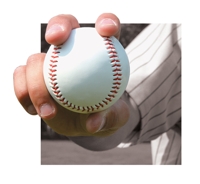
A two-seam fastball is a variant of the straight fastball. It is similar to the sinker. The pitch has the speed of a fastball, but the general movement of a screwball. The pitcher grabs a baseball and finds the area on it where the seams are closest together. Then, the baseball is thrown like a four-seam fastball, with the index and middle fingers on each of those seams. The fingers can also be placed across the two seams. Each finger should be touching the seam from the closest to the palm of each finger. The thumb should rest underneath the ball in between the index and middle fingers, finding the apex of the horseshoe part of the seam. The thumb needs to rest on that seam from the side to the middle of its pad. The two-seam fastball is designed to have more movement than a four-seam fastball, but can be more difficult to master and control.
Curveball
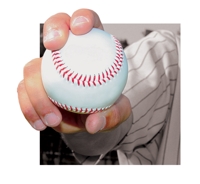
The curveball, is a type of pitch thrown with a characteristic grip and hand movement that imparts forward spin to the ball. It is therefore considered a type of breaking ball (referring to the sense of the word break as in to quickly or suddenly move). As opposed to a fastball which has only backspin, the curveball instead has topspin that causes it to drop more as it is in flight. Additionally, because of mechanics of the throw, the pitch is usually significantly slower than the fastball. Curveballs may further trick the opponent by first appearing to be a ball while then curving into the strike zone. Likewise, a curveball may appear to be headed for the strike zone and end up curving outside the strike zone. When throwing a curve, the pitcher creates downspin by rolling his palm and fingers over the top of the ball while releasing it. The direction of the break depends on the axis of spin on the ball. There are many variations of the curveball, but most are described in terms of their movement when superimposed on a clock. A "12-6" or "overhand" has a more or less straight downward action as it approaches the plate while more sweeping curveballs might be described as "1-7" or "slurves."
Circle Changeup
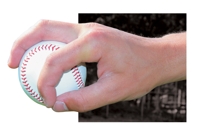
The circle changeup is thrown with a grip that includes a circle formation, hence the name. The circle is formed by making a circle with the index finger, holding the thumb at the bottom of the ball parallel to the middle finger and holding the ball far out in your hand. The ball is thrown turning the palm out.
Split-Finger Fastball or Splitter
Tag(s): Columns Pitching Columns Home All News

Comments
Let’s get the conversation started! Post your comment.